
When choosing a Windows operating system for specialized environments, the decision often comes down to Long-Term Servicing Channel (LTSC) versus standard, feature-updating releases (commonly referred to as non-LTSC or GAC). While both have their place, LTSC stands out as the superior option for purpose built devices and systems designed to perform a specific function reliably over time.
Understanding the Difference
LTSC (Long-Term Servicing Channel) is a version of Windows designed for stability and longevity. It receives security updates and bug fixes, but no feature updates over its lifecycle (typically 10 years).
Non-LTSC (General Availability Channel) versions of Windows—like Windows 11 or Windows 10 standard editions—receive frequent feature updates, UI changes, and new functionality multiple times per year.
Why LTSC Is Better for Purpose-Built Devices
1. Stability Above All Else
Purpose built devices such as ATMs, medical equipment, kiosks, POS, and industrial controllers, depend on consistent behavior. LTSC eliminates the risk of unexpected changes caused by feature updates.
With LTSC:
-
The OS environment remains consistent for years
-
Applications behave predictably
-
Certification and validation processes don’t need constant repetition
In contrast, non-LTSC updates can introduce:
-
UI changes
-
API modifications
-
Compatibility issues
These changes can disrupt tightly controlled systems.
2. Reduced Maintenance and Downtime
Frequent updates in non-LTSC systems require:
-
Testing before deployment
-
Scheduled downtime
-
IT intervention
LTSC minimizes this burden:
-
Only critical security updates are delivered
-
No forced feature upgrades
-
Lower operational overhead
This is especially critical in environments where downtime is costly or unacceptable.
3. No Unnecessary Features or Bloat
LTSC versions intentionally exclude consumer oriented applications and features such as:
-
App store integrations
-
Preinstalled apps
-
Rapid UI experiments
This results in:
-
A leaner OS footprint
-
Lower resource usage
-
Fewer attack surfaces
Purpose built devices benefit from having only what they need—nothing more.
4. Long-Term Support Lifecycle
LTSC provides extended support (often up to a decade), making it ideal for devices with long deployment cycles.
For example:
-
Industrial machines may remain in operation for 7–15 years
-
Medical devices require regulatory stability
-
Embedded systems are rarely upgraded
Non-LTSC systems, with their shorter support cycles and frequent upgrades, are not designed for this kind of longevity. While Windows 10 support officially ended on Oct 14, 2025, LTSC versions still receive security updates until 2029 or later depending on the version you are running.
5. Improved Security Through Simplicity
While non-LTSC versions receive new features, they also introduce new code, and with it, potential vulnerabilities.
LTSC’s approach:
-
Focuses on patching existing components
-
Avoids introducing unnecessary changes
-
Reduces the overall attack surface
For fixed-function devices, this model often results in a more secure and predictable system.
Conclusion
For purpose-built devices, LTSC is the clear winner. Its emphasis on stability, minimalism, and long-term reliability aligns perfectly with systems that must operate consistently over many years.
While non-LTSC versions like Windows 11 PRO bring innovation and new features, those benefits come at the cost of change and unpredictability—two things purpose-built systems simply cannot afford.
In environments where “it just works” must remain true for years, LTSC isn’t just the better choice—it’s the right one.
What version comes on my device
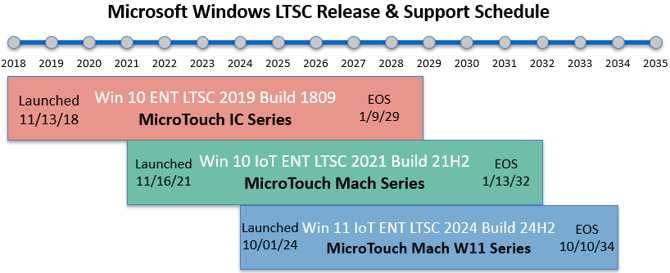
MicroTouch IC Series Windows AiO devices ship with Windows 10 ENT LTSC 2019.
MicroTouch Mach Series Windows AiO devices ship with Windows 10 IoT ENT LTSC 2021.
MicroTouch Mach Series W11 Windows AiO devices ship with Windows 11 IoT ENT LTSC 2024.
Updating LTSC Versions
It is important to note that LTSC licenses do not allow updating to other builds. So, if your license is for build 1809 you cannot update to build 21H2 without purchasing a new license.
If you have question, or additional information, please reach out to our support team - Details below:
Sign up for our Customer Portal. The portal provide a home base for you to interact with MicroTouch support and services teams. It gives your a secure place to track and manage all open and closed support tickets—or file a new ticket—they move issues along at your own pace, see ticket activity and be reassured that your problems are being addressed. The portal also provides the most efficient method to initiate an RMA.
Launch a Ticket with our technical resource center. The center is here to support you M-F, 8 AM to 5 PM EST.